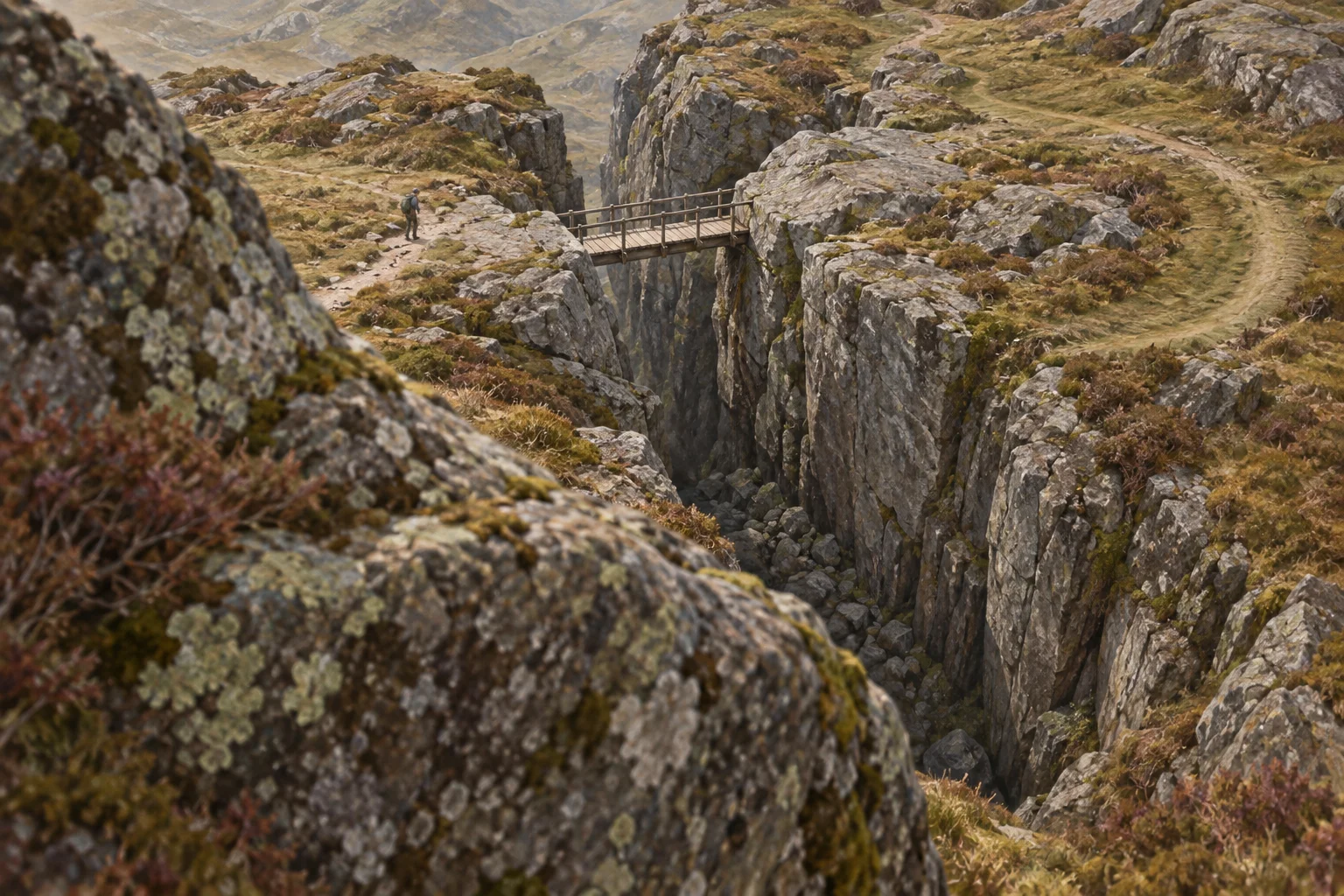
Faint paths appear in an unmaintained field because people keep choosing some routes more often than others. Each walker responds to the ground in front of them. As thousands of those decisions accumulate, their footprints leave a route that the next person can follow without making every decision again.
A method can preserve experience in much the same way. Following it saves work, but the instructions may no longer explain why an earlier traveler chose that route. That matters when the terrain changes, or when your destination differs from theirs.
The Wisdom Compressed into Terrain
A path preserves the result of many small decisions: someone avoided a rock, followed a contour, or found a place to cross. Later walkers receive the instruction "go this way" without having to reconstruct those decisions. This is lossy compression because the route survives while the reasons for it disappear.
The Silk Road developed through merchants independently crossing terrain and sharing information about hazards and conveniences, rather than through a single empire's plan. Their routes converged around water sources, passages free of bandits, and usable mountain passes. Someone following the resulting route benefits from those discoveries even when they cannot say which of them explains a particular turn.
Paving makes the route clearer and more durable. On an unmarked journey, you have to keep checking a map, comparing it with the ground, and deciding what to do at forks. Those decisions occupy working memory. A paved path puts the route in the terrain itself, so you can follow it without repeatedly reconstructing where to go.
The cost comparison used here is roughly 6 units for each navigation decision versus 0.5 units for following the route through the journey, a 12:1 difference. For a beginner, that overhead competes with the willpower needed to perform the activity. An established route lets them spend more of their effort learning to do the work. Once basic competence is in place, they have more capacity to explore alternatives.
Inspect the crossing
A path can remember a reason its next walker cannot see.
The worn path bends around the hill. Inspect the crossing to see what it avoids.
A designed thought experiment from Paths and Trailblazing. Change the crossing, then compare it with the route people already follow.
What Gets Lost in the Collapse
When the path goes around the hill instead of over it, the follower doesn't know why. Maybe the hill is too steep. There might be impassable ground on the far side, or a rockfall hazard that makes the shorter route deadly. Earlier casualties may have established the need for the detour, but the path preserves only the instruction to go around.
Chesterton's Fence applies here: understanding why a route takes a detour matters before replacing it with a shortcut. A novice sees the shorter distance and expects to save time. If they then encounter a 60° slope or ground they cannot cross, their failed attempt recovers information that was missing from the instructions.
Sometimes a shortcut becomes possible. A bridge is built, a road is paved, or a hazard disappears. Someone has to test the alternative before other travelers can adopt it. If it works, the route shifts; if it fails, the failure confirms a reason to retain the detour. Variation, selection through success or failure, and inheritance through later travelers allow the route to adapt, at the cost of individual experiments that can end badly.
The surviving path also leaves out most of those failed experiments. It shows where people traveled and lived, while routes on which people died may be represented only by their absence. That is survivorship bias in the information available to a follower.
Beacons Versus Documentation
A beacon supplies enough information to keep someone moving: "Turn left at the split rock" or "After steep climb, look for red tree." Documentation preserves the reasons as well. "Turn left because right path has 60° slope" lets a traveler evaluate the alternative. "Red tree marks campsite with water access" explains what the landmark provides. A note such as "Tried going over hill Day 3, impassable, go around" preserves a failed experiment that the path alone cannot show.
Beacons are quick to follow because they leave out the reasoning. Full documentation takes longer to create, but preserves that reasoning without the loss involved in reducing it to a marker. A traveler can use a documented reason to judge whether changed conditions make the old route obsolete. With markers alone, they may have to repeat the dangerous experiment to find out.
The wiki aims to provide that documentation. "Do 30 days" gives someone a duration; the explanation of the observed change from high activation cost to automatic execution gives them a reason to use it and a basis for adapting it. Making the reasoning explicit also lets one article support another through a link, so the work spent on an explanation can help readers of several connected topics.
Paths Enable Exploration
An established path can also provide a base for exploring unfamiliar ground. A traveler can follow it to a known destination, make a bounded excursion nearby, mark a useful discovery, and return. The known route supplies the guaranteed safe fallback that makes the excursion a calculated experiment rather than an attempt with no way back.
The distance they can explore depends on the cost of returning. Around each point on the route is a radius within which the traveler still has enough resources to get back. Beyond that radius, the return journey costs more than they can afford, and they become stranded. Carrying more supplies extends the radius. Placing beacons can extend it too, because the traveler no longer has to rediscover the return route.
That combination of exploration and marking is trailblazing. The excursion serves the person walking now, while the marks also serve other travelers and the same person on a later visit. A failed branch can end with a return to a validated checkpoint rather than the loss of the whole expedition.
Following Versus Blazing: When to Use Which
Following an established route is useful when others have already reached the destination, especially when you are learning the basics, have a limited willpower budget, or need speed more than novelty. A coding tutorial, Starting Strength, or a standard technology stack for an MVP lets a beginner use experience accumulated by thousands of people instead of solving every preliminary problem again.
Trailblazing becomes necessary when no route reaches the destination or when a general route does not fit the constraints. Research, a new product category, and personal N=1 optimization all involve this problem. Someone who has mastered an established approach may also explore because innovation is the purpose of the work. The wiki's integration of computational thinking and behavioral practice is another example of a destination for which no established route exists.
Competence in an existing method provides a starting point for that exploration and a fallback if an experiment fails. Abandoning every established method at the outset removes both advantages. A beginner can then exhaust their resources repeating basic mistakes without learning how to return to something that works.
Wandering Versus Trailblazing
Wandering can produce discoveries without any intention to preserve a route. It is useful for creativity and generating ideas. Trailblazing adds the intention to record decision points so that another person, or your future self, can repeat the useful part of the journey.
The wiki uses both activities. A braindump allows unconstrained exploration. An article develops a valuable discovery into an explanation that someone else can follow. The documentation is what makes the exploration reusable.
A beacon can mark the completion of one segment and indicate the next. Connecting two milestones is the smallest useful unit of this work, corresponding to one edge in a knowledge graph. Someone first has to decide that a point deserves to be marked. Discretization separates it from the surrounding experience, and salience makes it stand out as something worth returning to.
The Useful Metaphor of Neural Pathways
The path metaphor describes the observed costs of behavior; it is not a claim about literal neuroscience. A new behavior can cost roughly 6 units of effort to initiate, then fall to around 0.5 units after daily repetition for about 30 days. The 30x30 pattern records this reliable cost curve across N=1 experiments. The practical observation does not depend on whether myelination, synaptic strengthening, or another mechanism explains it.
The progression can be pictured as a route becoming easier to follow. Day 1 feels like crossing unmapped ground. By Day 7, a faint trail is visible, and during Days 8-15 it becomes easier to use. At Day 16 there is a clear path; through Days 16-30 it becomes well marked. By Day 31+, behavior runs almost automatically, like travel on a paved highway. The picture makes the change in effort and its timeline easier to reason about.
Repeated behavior also explains why an unwanted default can be so accessible. Checking a phone after work, opening YouTube when bored, and scrolling when anxious have each had thousands of opportunities to become familiar responses. Arriving home, opening a laptop, or feeling bored then supplies the context in which the familiar response runs. Calling these responses well-paved routes draws attention to their accessibility rather than treating their recurrence as a character judgment.
Establishing a new response initially requires more activation energy. The first week is costly, but repetition builds a route that becomes easier to use. Resisting the old response every day leaves that accessibility unchanged; paying the initial cost of establishing a better default changes what future repetitions demand.
"I lack discipline" gives no location at which to intervene. "the lounge_script highway is more paved than work_launch trail, I need 30 days to build the new route" identifies the competing responses and the period of practice. That is the metaphor's practical value: it makes a cost curve and an intervention intelligible without claiming to explain the underlying neurological mechanism.
The Mechanistic Mindset Wiki as Trailblazing
The wiki develops a specific integration of computational thinking with behavioral optimization: operational frameworks replace moral judgments about character, resilience protocols provide self-healing behavior, and night protocols apply pipelining to preparation for the next day. The synthesis is novel, so its instructions cannot yet rely on an established route that many readers already know.
For now, the documentation needs to explain why an approach should work, show failures and dead ends, and describe the conditions that matter. What works in Will's N=1 experiments may need modification in someone else's life. Full reasoning lets that reader make an adaptation instead of either obeying an instruction blindly or abandoning it without understanding what failed.
The eventual aim is shorter guidance supported by that accumulated experience. If thousands of people traverse and validate these routes, and enough N=1 experiments confirm that the patterns generalize, beacon-level instructions could become useful in the way "just do Starting Strength" is useful for a beginner today. The transition depends on that validation, rather than on deciding that the explanations have become too long.
This article began with an observation of faint grass indentations on a hiking trail. Connecting that observation to working memory, predictability optimization, and activation energy produced a way to examine what a useful route preserves. The title marks a place in the wiki; the article records the reasons for going there, the hazards, the alternatives, and the conditions under which the idea applies.
When a reader can recover the reason for a detour, they can test whether it remains necessary. Adding a documented connection therefore extends the ground from which later readers can explore safely. They inherit both a route and enough of the reasoning to continue the search.
Key Principle
An established path reduces the cost of reaching a destination that others have reached, while documenting its reasons makes it possible to judge where the route still applies. When the destination or constraints are new, a reliable return route and a record of the experiment allow exploration to produce knowledge that someone else can reuse.