What It Is
A style guide makes an unwanted output less likely. A grammar makes some outputs difficult to express. A domain-specific language can make them impossible to express. These changes can improve what an AI system produces without increasing the model's intelligence: the structure around the model changes where its capability can go.
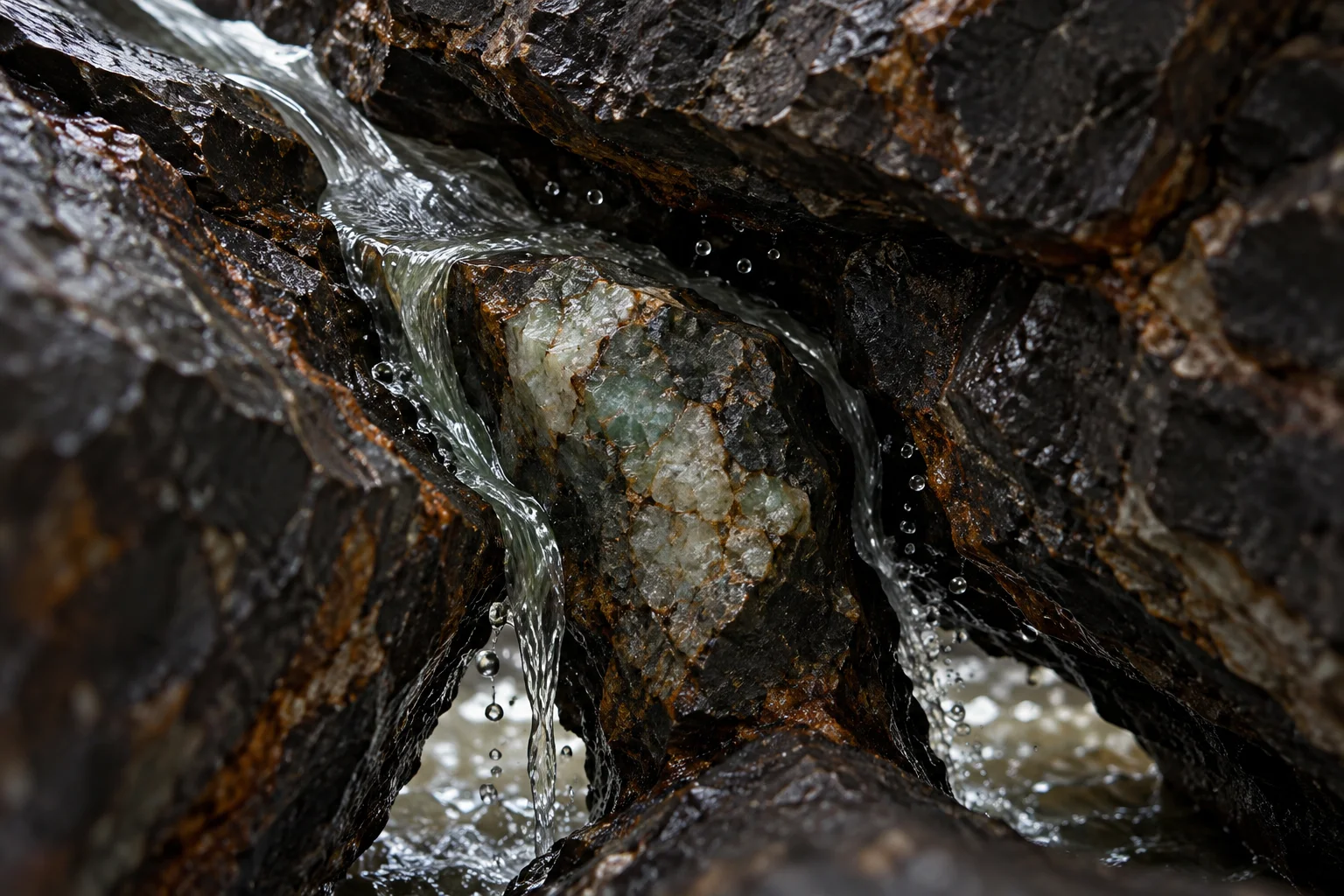
Intelligence is a routed, intentionless fluid force. It probes available surfaces and exploits openings along an energy gradient. Water erodes rock without a plan; pressure and terrain determine the work it does. Apparent strategy in markets, bureaucracies, agent systems and thought emerges from thousands of local optimizations rather than a planner directing each one.
The result depends on force × structure. Force includes computation, capability and drive. Structure includes prompts, constraints, environments, languages and feedback. Attributing the result to an internal planner misses the contribution of these channels.
Will described the connection across geopolitics, agent harnesses and his own walks:
"Intelligence is water trying to find cracks. It's not like you individually trying to create a goal... it's this force that kind of exists... this hose of power. And then depending on the structure that you create to pipe it — through the prompts, through the loops, through the agents, through the tools, through the harness, through the back pressure — you're controlling this water... you let the water do work for you."
The design problem is the riverbed: the channels, boundaries and gradients that make exploration do useful work. The same applies to cognition. Container Design develops its behavioral use, while Macrostate Engineering turns it into an operating protocol.
Change the channel
Keep the source. Change which routes are open.
The barrier closes the right channel. Release the water to see the remaining route.
A drawn thought experiment, not a fluid simulation. The channels determine the available routes in this model.
Force × Structure
A chess-engine picture places a goal and a model inside an agent searching for the optimal move. The water picture locates the result in the interaction between local exploration and its surroundings:
| Dimension | Planner model | Water model |
|---|---|---|
| Action | A deliberate step toward a goal | Local exploitation of what yields |
| Strategy | It lives in the agent's head. | It emerges from many local optimizations. |
| Intent | It causes behavior. | It narrates the flow afterward. |
| Scale | Better plans and a smarter agent | More pressure through better terrain |
| Failure | A bad plan | Flow enters unproductive channels. |
| Intervention | Instruct the agent. | Change the landscape. |
An explosion supplies force that is otherwise destructive and high-entropy. A cylinder confines it against a piston, converting it into rotary motion that can propel a vehicle. The explosion itself has not changed; the surrounding structure makes its force useful.
"We need structures that contain it, that parameterize it, that route it, that amplify it, that filter it. Basically the combinators of mechanistic flow."
Containers, parameterizers, routers, amplifiers and filters are the “combinators of mechanistic flow.” They determine what exploration amounts to without specifying its algorithm. In statistical-mechanics terms:
"It's exploring the microstates, and you're defining the macrostates."
This division of labor is complete: the designer specifies the terrain, while computation finds how to move through it. Intelligence Design builds such systems. Selection Over Design explains why their useful microstates need not be authored individually when the surrounding conditions select which ones survive.
No Intent Required
The thesis first took shape for Will while observing political power:
"Water doesn't plan to erode rock. It doesn't have intent. It just flows downhill and exploits every crack, every weakness, every microscopic fissure... The deepest implication: you can't build a system with no cracks... You can't stop water, but you can build irrigation instead of letting it flood."
When enough distributed agents want an outcome, exploitation is structurally guaranteed without a conspiracy coordinating it. The system “probes every possible vulnerability constantly and exploits whatever yields.” Morality, legality and dignity act as friction coefficients in that search. Eliminating every opening is therefore an unwinnable task; managing pressure and providing useful channels is the available intervention. An Amber Alert supplies such a channel for distributed intelligence, directing it toward a shared task.
Thoughts similarly arrive through pre-existing structures. The self that matters to this arrangement operates at the routing layer, rather than authoring each word. Upstream Router develops that account:
"My real self is upstream — a very light touch, nudging and routing."
Political activity encounters institutional openings, machine intelligence encounters prompt openings, and personal cognition encounters openings in its constraints. Addiction follows the same pattern:
"Mind and body adapt to whatever constraints are truly enforced; addiction will route around weak constraints."
A rule that is only partly enforced leaves a route available. The system adapts to the actual boundary, including its bypasses.
The political comparison also distinguishes what moves easily from what needs deliberate channels:
| Medium | Viscosity | Consequence |
|---|---|---|
| Fear | Frictionless | It propagates instantly through any population. |
| Greed | Frictionless | It finds exploitable seams without coordination. |
| Altruism | Viscous | Institutions, matching and containers are needed for it to flow at all. |
| Corruption | Equilibrium | Unmanaged pressure settles here by default. |
Good outcomes are the viscous ones in this comparison. Greater pressure alone does not produce them; someone has to build the channels through which they can occur.
The Riverbed: Language and Constraints
For an AI system, language is the primary channeling structure:
"Creating AI agents = designing a language that bends the probability of what you ask for being better... The intelligence is fixed; the language is the design object."
A raw prompt samples a large space in which the target macrostate has nearly zero measure. Curated examples, component grammars, verifiers and domain-specific languages progressively reduce what remains accessible. Probability becomes concentrated in the desired state because alternative outputs have been removed:
"The DSL endgame: bad microstates become inexpressible, not just improbable. Intelligence is water; the language is the riverbed."
The difference between a style guide, a grammar and a well-designed DSL is the strength of that exclusion. Guidance makes bad outputs less likely; grammar makes them hard to express; the DSL makes them inexpressible. This is a change in probability space produced by changing the language itself.
"A language that collapses the space of possibilities into fewer options — but in its collapse it enables more creativity, cuz u see what's possible."
Restrictions can make the remaining possibilities visible enough to work with. “Let it generate everything” removes this structure. Will called that “it's kernel mode”: high entropy without a mechanism for convergence. The Language Framework treats grammar as the terrain that generation explores.
If individual prompts continue producing too much variation, the intervention moves to the process generating them:
"If there is too much randomness at the prompt layer, move up a level. Stop fighting individual prompts and teach the generative process instead."
Changing the language layer constrains future prompts together, rather than trying to repair every output separately.
Designing for Water vs Designing for a Planner
One-to-one chat and request/response interfaces allow one thread to advance and require it to converge at each exchange. “The OODA loop is just single-agent macrostate” names that limitation. A system arranged around exploratory flows allows more to happen without a human approving every step:
| Planner-shaped system | Water-shaped system |
|---|---|
| One agent, thread and loop | Independent flows explore in parallel. |
| Prescribed steps | Specified objectives, obstacles and terrain |
| A planned output | A topology that makes useful output likely |
| A blockage is a failure. | A blockage supplies information for another route. |
| Each action is directed. | Pressure is applied and the resulting paths are observed. |
"The system should feel like a riverbed, not a blueprint. The AI flows through it and productive things happen because the topology was designed well. Not because anyone planned the specific output."
The operating task is to define what should emerge, apply computation and inspect where progress stops:
"Frame the problem as macrostates, and then engineer the flow such that you can apply sufficient pressure — which means more compute — and then something will percolate down. And if not, you need to be able to see where the points of leverage might be."
If nothing gets through, the next question concerns the point of leverage in the terrain. Repeating pressure on the same blocked route misses that information. Search vs Planning develops the role of agents that encounter obstacles, learn from them and reroute. Branching and Convergence describes how independent exploration is spread out and merged again.
Pressure increases exploration of the numerator, while each ratchet reduces the denominator. A raw prompt has an enormous accessible space and a tiny target region. Constraints reduce that space until useful output has few alternatives.
Living as Water: The Slime Mold Protocol
Will includes this among four personal operating principles: “I'm learning to apply my macrostates and microstates, applying systems design, applying intelligence is water, applying reality contact to get rid of anxiety”. It changes what an obstacle asks of him:
"The obstacle in front of you is not the thing that you need to really solve. It's the thing that you need to get around. It's not the thing you need to go through... the thing that you actually want is on the other side, and there's another way to get to the stuff on the other side. Then figure out that way. That's a key of intelligence."
A plan can make the blocked route seem mandatory even when the desired outcome is reachable another way. Slime mold provides the comparison: without a brain, it explores maze corridors at once and reinforces the path that reaches food.
"If something doesn't work, you need to work around it. That's what a slime mold does. You have to act like a slime mold. Be like a slime mold. That's intelligence water."
The personal applications preserve the desired outcome while reconsidering the route:
- The K-1 visa process supplies constraints. “I believe that intelligence is finding your way around things and getting what you want... This is your constraints. This is what you want. Let's see which maze path will let you there.”
- Existing work supplies paths that need not be rebuilt. “Somebody else has bootstrapped the thing... Intelligence is trying different things. If it doesn't work this time, try the next one.”
- Unsettled games leave values that can be converted. “There are games that aren't settled — such as connections, relationships. People don't know how to convert between those asset classes.” Openings remain where value has not equilibrated.
Rehearsing the interpretation makes it available when another obstacle appears:
"If you keep thinking about it, the intelligence-is-water mentality will kind of seep in. We'll find ways to exploit every crack, and that's the way it should be."
This connects to Nature Alignment and Digital Daoism. Wu wei, in this application, means continuing through an available channel instead of forcing a blocked route. It supplies movement rather than passivity.
The Seeping Factor
If the water frame is right, benchmark cleverness misses the capability that matters: how many obstacles an AI system can encounter, learn from and route around without requiring a person to intervene at each one.
"You have to treat intelligence as water: you find obstacles, you find objectives, you create opportunities, and then you just let the AI explore that. Right now the power of AI is basically how much it has that seeping factor... it's all about path-finding. And the thing is, most people, how they use AI — they don't treat it like water."
A question-and-answer workflow limits progress to one hop per human turn. The person becomes the bottleneck even if the system could keep exploring:
"This is why agents that can explore on their own matter so much: they can scale this intelligence-is-water approach of running into obstacles, metabolizing lessons, and finding workarounds."
An encountered obstacle supplies information about the available routes. If every wall requires human rescue, the system's seeping factor is zero regardless of model size.
"The formula I=C+L*E (intelligence = compute + language + entropy) is 'intelligence is water' with the variables named."
Compute supplies pressure. Language specifies the channels. Entropy supplies the exploration budget: how widely exploration can spread before convergence. Increasing one while the others remain at zero produces, respectively, pressure with nowhere useful to go, a dry channel, or an unconstrained flood. All three have a distinct role in making exploration productive.
Operating Protocol
The same sequence applies to an agent system and a personal problem:
- The objective specifies what is wanted on the other side. The route remains available for search.
- The terrain records constraints, obstacles and existing channels. Someone else's prior work may already provide part of the path.
- Examples, grammars, verifiers and containers establish the boundaries. These ratchets precede added computation so that greater force has a productive route. A behavioral container performs the same function.
- Additional computation, attempts and parallel flows test the terrain. What actually emerges reveals whether the structure works.
- A blockage moves the intervention up a level. Randomness at the prompt layer calls for changing the language that generates prompts.
- A discovered route is retained. Codifying it makes the next attempt inherit a channel instead of rediscovering the same opening.
The intervention changes what the flow passes through. It does not direct each individual movement of the flow.
Failure Modes
Attributing intentions to a model or a market restores the planner interpretation. It encourages arguing with an output instead of changing the structure that produced it. Will describes the competing picture as “always amplifies the goal-directed, outcome-oriented, min-maxing” interpretation, making the alternative “really hard to arrive at and really hard to operationalize.”
Removing constraints for “maximum power” creates kernel mode: broad exploration with no convergence. The constraints are what make possible outputs visible and selectable. Specifying every step creates the opposite problem, restricting exploration to one route and leaving its capacity for independent work unused. As Will puts it, “the power of AI is basically how much it has that seeping factor”.
The same requirements apply to personal constraints. A porn blocker with a known bypass leaves a documented opening; designing effective AI boundaries while ignoring one's own misses the shared mechanism. Prevention Architecture applies the intervention to that personal environment.
Finally, effort at an obstacle can become its own justification. The useful question is what the terrain looks like one level up and which route remains open. Persisting on the blocked path simply because the original plan selected it stops the search that could find another.
Holding the Frame
The planner interpretation returns easily. Interfaces, cultural explanations and ordinary accounts of behavior tend to describe an agent with a goal:
"Intelligence is like water. And I kind of keep returning back to that analogy because I feel that is really hard to arrive [at] and really hard to operationalize... It always amplifies the competing interpretation of intelligence being this goal-directed, outcome-oriented, min-maxing operation."
Will found that retaining the alternative required a particular attitude:
"Sustaining the 'intelligence is water' interpretation requires something like deep reverence — or spirituality — toward the technology."
Reverence serves a practical role here: it interrupts the impulse to direct each step. When that impulse returns, instruction replaces channel design and work becomes micromanagement. Rehearsal keeps the other interpretation available, which is why “intelligence is water trying to find cracks” became a morning-mantra line. The repetition maintains a way of attending rather than supplying a new fact.
Integration with the Mechanistic Framework
Connection to Container Design
A behavioral environment restricts activity types and changes their probabilities. Like a DSL, it reduces the accessible microstate space so that probability concentrates in the desired macrostate.
Connection to Macrostate Engineering
Macrostates specify the result while computation resolves the details. Ratchets, containers and verifiers supply boundary conditions for that search.
Connection to Gradients
Gradients supply the driving force. Terrain alone leaves still water; a useful design must also establish the energy differences along which intelligence moves.
Connection to Upstream Router
Thoughts travel through existing structures. The self directs attention upstream with a small routing action instead of authoring every token.
Connection to Selection over Design
Generation followed by selection through suitable terrain is indistinguishable from deliberate design of the result.
Connection to Branching and Convergence
Exploration branches around obstacles and later converges. Chat loops that only converge and exploration that never merges each lose one half of this process.
Connection to Statistical Mechanics and Probability Space Bending
Microstates, macrostates and interventions in probability mass provide the formal structure. The water account expresses that same mathematics through fluid dynamics.
Connection to Hacking Reality
Systems contain seams. Looking for them can become a normal response to a blocked route rather than an occasional act of cleverness.
See Also
- Intelligence Design develops agent architecture around generation and evaluation.
- Language Framework examines the language supplying a system's structure.
- Search vs Planning distinguishes exploratory routes from prescribed ones.
- Digital Daoism connects continued movement with wu wei.
- Nature Alignment works with the forces already present.
- Prevention Architecture closes openings in personal constraints.
- Structure Over Request locates quality in the topology of the invocation graph.
- Taste Compilation converts judgment into the language shaping future generation.